Whoever was in charge of the Fitocracy update is going to be in trouble. An update a 6am on a Saturday going bad… Who would have guessed!
Whoever was in charge of the Fitocracy update is going to be in trouble. An update a 6am on a Saturday going bad… Who would have guessed!
More follow-up from the afore mentioned Frostcast featuring Manjaro developer Philip Müller. Just past the 16 minute mark.
We learn and everyone makes mistakes. And the new server change every package is new synced from Arch Linux so there is no security issues. … We sync daily so if there is any problems with our system it’s ninety percent from Arch itself, so I don’t know why they bash us.
I am not going to claim Arch is the bastion of all things security – in fact I know Arch is far from perfect here – but Manjaro claiming that they are on par with Arch is wrong. Saying “we sync daily” is frankly deceptive. The daily syncs are to the Manjaro unstable branch, so packages can take a while to reach the stable branch where the vast majority of users get the package. As I have pointed out previously, Arch does not separate out security updates from plain upstream updates, so when Manjaro holds back updates on the unstable branch in the name of stability, they are also holding back security fixes. The updates need monitored for security fixes and either 1) pushed more quickly to the users, or 2) have the fixes backported to the “stable” packages.
But, lets use an example, because facts are good. Recently there was an privilege escalation issue found in polkit. This was made public on 2013-09-18. And over the next couple of days there were a lot of distribution updates to fix this issue. So, I have not picked an obscure bug given the number of distros dealing with the issue, and it is a privilege escalation one (potentially with proof-of-concept available, although I have not checked that out). Lets compare the Arch and Manjaro response to this issue by monitoring the location of the polkit-0.112 package:
| Date | Arch | Manjaro |
|---|---|---|
| 2013-09-18 | Testing | – |
| 2013-09-19 | Stable | – |
| 2013-09-20 | Stable | Unstable |
| 2013-09-21 | Stable | Unstable |
| 2013-09-22 | Stable | Unstable |
| 2013-09-23 | Stable | Unstable |
| 2013-09-24 | Stable | Unstable |
| 2013-09-25 | Stable | Unstable |
| 2013-09-26 | Stable | Unstable |
| 2013-09-27 | Stable | Unstable |
| 2013-09-28 | Stable | Testing |
| 2013-09-29 | Stable | Testing |
| 2013-09-30 | Stable | Testing |
| 2013-10-01 | Stable | Stable |
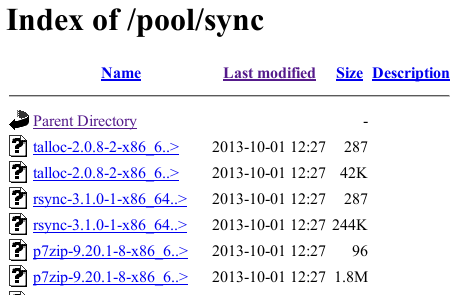
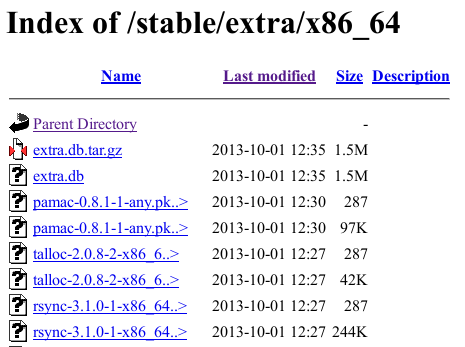
I will admit that this is actually better than I thought it would be… I thought packages stayed longer in Manjaro’s testing repositories to catch bugs. Then again, I noticed that there are packages that were pulled into Manjaro from Arch and put into their stable repos within ten minutes, including packages in the [core] repo, so I’ll assume that the testing that occurs in the Unstable and Testing branches is rather limited. (Evidence: pool/ directory with timestamp file was synced from Arch, stable/extra/x86_64/ directory with repo database timestamp.)
In summary, the indiscriminate holding back of all updates in the name of testing(?) is why I “bash” Manjaro security. With this system, Manjaro is always running behind Arch, so claiming the Manjaro security issues are “ninety percent from Arch itself” is full of… optimism. And before the “leave Manjaro alone” comments, I will stop posting about it when I have no need to correct such false statements.
Lets list some links!
And some fun…
I was listening to Frostcast in the background today when I heard my name. That always makes me pay some attention. Then I heard wrong information. I don’t know why I care, but I do… so here goes the clarification.
The quote from Philip Müller at 14:35 into the podcast:
The lastest news was Allan McRae – he is a developer of pacman himself – he sent me an email to send over all the translations of Manjaro distribution does. So I forked pacman, and pacman itself has 20 translations and our branch has 44 translations of the same software so Arch Linux is asking us to be upstream and give them our translations…
OK… This is interesting. Time for some background here. When pacman-4.1 was released, we removed the broken SyncFirst option. This is needed by Manjaro Linux to run their update helper script that “fixes” the update process to remove any manual interventions. So Manjaro reverted our patch and brought back SyncFirst to pacman. That required three additional strings to be translated for their version of pacman so they also forked our translation project on Transifex.
As the Arch and Manjaro versions of these projects had started to diverge, I wrote to Phil noting that people were doing more than just translating those three additional strings, and it would be good if the translators were pointed at the Arch project so we all benefited, given the Arch project is the one the pacman developers set up.
Lets compare the status of the Arch and Manjaro translations as of 2013-09-24. There are 24 languages with complete translations in the Arch projects, and being nice and ignoring the additional three strings in the Manjaro project, they have 23. (Of those 23, only 6 actually have the additional three Manjaro strings translated). What are the differences? Manjaro has a complete Hungarian translation while Arch has complete Korean and Romanian translations. The Arch Hungarian translation is at 99%, while the Manjaro Korean and Romanian are at 21% and 62% respectively. So it is clear these languages have diverged since the split, with most of the work done in Arch.
Of the remaining languages with incomplete translations, Manjaro has 19 languages, while Arch has 15. Clearly not a total difference of 20 to 44 languages as claimed. Looking at these in more detail, 9 languages have not deviated between the two projects. The Arabic, Chinese (Taiwan), Dutch, Galician, Polish, Serbian (Latin) translations have all got additional translations in the Arch project since the split with the Manjaro project. So apart from languages that have been have had translations started in Manjaro but not in Arch, the Arch project is behind in 3 strings for the Hungarian language.
Maybe where the Arch translation project for pacman could gain is from the new languages in the Manjaro translation: Czech (Czech Republic) [99%], Bulgarian (Bulgaria) [62%], Uzbek [14%] and Danish (Denmark) [3%]. Also note that 3/4 of those languages have a sub-name there. Taking “Danish (Denmark)” as an example, there is already a “Danish” translation (language code: da) and this is adding a Denmark specialization (language code: da_DK). I might be entirely wrong here, but are there other variants of Czech, Bulgarian and Danish apart from their primary usage, or are these exactly the same and the work is just being repeated?
In summary, the translation project set up by the pacman developers is, and will remain, the upstream translation. I just approached Manjaro to send their translations our way so we would both benefit. Arch from (potentially) more translations, and it would be easier for Manjaro to merge their string translations without ending up removing several hundred perfectly good translations.
A few months ago Dusty posted about creating an Arch Linux community on Gittip. For those that do not know what Gittip is, it is a way to make small donations weekly to “to people you love and are inspired by”. Due to his pushing for people to join up, this community is now “official” in Gittip land, which means it has 150 members.
I have joined up because I always need money to buy things that I otherwise would not. And I need to give a big thank you to those that have tipped me so far.
I’m not one to get carried away, but lets take a look at the last three weeks. I received $1, $2.25 and $4.25. If we fit a line through those, we get:

where, y is the amount tipped for week x (x = 1, 2, 3, …). [Aside: I would figure out how to do pretty formulas, but no-one wants much math in a blog post, or anywhere…]
Anyway, if we take that formula and look at my projected tips for the next while:
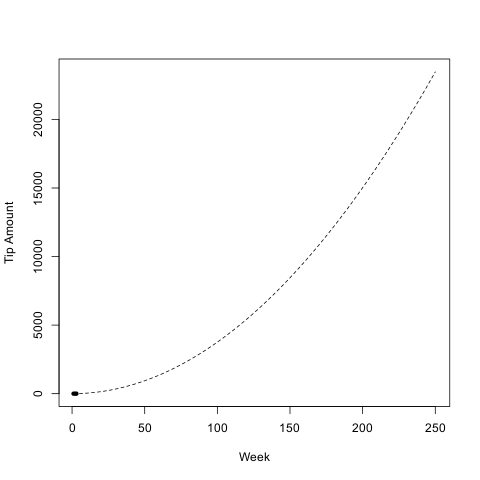
Now I can start extrapolating that at some stage in the next two years, I will be getting enough tips to quit my job and work on Arch full time. Also, before five years have past I will get $20,000 a week, which converts to ~$1,000,000 a year.
So this has been much more successful than I could have ever imagined! When I am bringing in the millions I will have a party for Arch Linux users in my luxury beach-side property.
Don’t you love messages like “This video is not available in your country”. That generally means it is not available outside the USA (unless you are in Germany in which case it means it is available anywhere but your country). They have finally annoyed me enough to do something about it and my web server is based in the USA so it should be easy… Right?
It turns out that while it should be easy, it took me far longer than expected, mainly because I found most tutorials assume you know things. Also, I found the Arch wiki not to be great in this area (and as you may notice below, I am not the person to fix it). So here is yet another “guide” on how to set up OpenVPN on your server and getting both Linux and Windows clients to access it (mainly posted as notes in case I need to set this up again in the future).
Step #1: OpenVPN
The first thing that needs done is the creation of a personal Certificate Authority and generating the needed keys for your server. Fortunately, OpenVPN comes with a set of scripts called easy-rsa. I am not going to cover this as these scripts are well documented and do all the work for you.
I am also not going into all the configuration of OpenVPN. But here is an /etc/openvpn/server.conf file I found to work:
dev tun

proto udp

port 1194


ca ca.crt

cert server.crt

key server.key

dh dh1024.pem


user nobody

group nobody


server 10.8.0.0 255.255.255.0


persist-key

persist-tun


client-to-client


push "redirect-gateway def1"

push "dhcp-option DNS 8.8.8.8"


log-append /var/log/openvpn
Not that the configuration file can be called anything you want. OpenVPN is launched using “systemctl start openvpn@server.service“, where “server” in this case is because my configuration file is “server.conf“.
The only bit of configuration I will directly mention is setting up users to be able to access the VPN using a username/password approach rather than generating individual keys for each client. This is purely because I am a lazy admin and everyone I want to use my VPN has an SFTP shell on my server already. Just add this to your server configuration file:
plugin /usr/lib/openvpn/plugins/openvpn-plugin-auth-pam.so login

client-cert-not-required

username-as-common-name
OpenVPN does give warnings about this configuration, so consider the security implications if you use it.
Step #2: Enable forwarding
By default, packet forwarding is disabled. You can see this by running:
$ cat /proc/sys/net/ipv4/ip_forward

0
We can enable this by adding these lines to /etc/sysctl.conf:
# Packet forwarding

net.ipv4.ip_forward = 1

net.inet.ip.fastforwarding = 1
Note that the file /etc/sysctl.conf is not going to be used from systemd-207 onwards, so this will need to be move the appropriate place. Also, the “fastforwarding” line is purely based on anecdotes I found on the internet, and may not do anything at all! In fact, I think it is a BSD thing, so I have no idea why I am mentioning it. Moving on…
Step #3: iptables
If you have iptables running, you will need to open up access to the VPN. You also have to forward the VPN client traffic through to the internet. This is the bit I found least documented anywhere. Also, I am not an iptables expert, so while this works, it might not be the best approach:
# OpenVPN

iptables -A INPUT -i eth0 -m state --state NEW -p udp --dport 1194 -j ACCEPT


# Allow TUN interface connections to OpenVPN server

iptables -A INPUT -i tun+ -j ACCEPT


# Allow TUN interface connections to be forwarded through other interfaces

iptables -A FORWARD -i tun+ -j ACCEPT

iptables -A FORWARD -i tun+ -o eth0 -m state --state RELATED,ESTABLISHED -j ACCEPT

iptables -A FORWARD -i eth0 -o tun+ -m state --state RELATED,ESTABLISHED -j ACCEPT


# NAT the VPN client traffic to the internet

iptables -t nat -A POSTROUTING -s 10.8.0.0/24 -o eth0 -j MASQUERADE
If your default iptables OUTPUT value is not ACCEPT, you will also need a line like:
iptables -A OUTPUT -o tun+ -j ACCEPT
I have not tested that set-up, so you may need more.
Step 4: Clients
I went with using NetworkManager on Linux and the OpenVPN client on Windows. Note the two different Windows clients on that site are exactly the same, so there is no need to figure out the difference.
The Windows client requires a “.ovpn configuration file. Here is an example:
client

dev tun

proto udp

remote foobar.com 1194

resolv-retry infinite

nobind

persist-key

persist-tun

ca foobar.crt

verb 3

auth-user-pass
The only thing to note here is the “ca” line is the public certificate you generated in Step #1. Even with password authentication, you still need to provide that certificate. Also, it is important to have the compression setting being the same in both the server and client configuration. Given I mostly want to use the VPN for video, I have not enabled compression.
And there you have it. Configuring that took me much too much time, but now I can pretend to be in the USA and watch all the content that is geolocked to there that I want. Which as it turns out, is not often. I have only watched one video in the month since I set this up. Good use of my time…
Better do this months post on time!
And for your amusement…
Oops… never posted this at the end of July. And there was so many links. You will get over it!
Distro and software news:
And some other stuff…:
Who knew? A char on ARM is unsigned. Turns out, lots of people knew… (I was hitting the EOF test issue.)
While I was on holiday I learned something about crocodiles. They are very considerate and intelligent. Take this crocodile for example:

It does not want to endanger humans, so it hangs out under a sign telling people to keep away. Also, note the crocodile is looking slightly confused (it takes quite a bit of experience to read crocodile emotions, so you may miss it). A closer inspection of the sign tells us why. A warning written in German in Australia? A good query for a crocodile. But he obviously had not read about German tourists and their “success” at going near the water in the region.
While we are talking about warning signs in Tropical North Queensland, I have seen enough anime to know where this is heading…